
Colored Girls for Colored Girls—
Evolution of Expression
August 19, 2026 - November 15, 2026
Ntozake Shange’s for colored girls who have considered suicide / when the rainbow is enuf endures as a foundational work in Black feminist cultural history. Since its debut in 1976, the choreopoem has articulated intimacy, grief, resilience, and collective strength through a form that continues to shape how Black women’s lived experiences are seen, felt, and understood. This dynamic, soulful, emotionally empowering expression of resilience, love, courage, and vulnerability provides all who engage a guided tour into the emotions and unmatched strength of Black women.
Colored Girls for Colored Girls—Evolution of Expression utilizes a creative parallel by framing its thematic concept to the original chorepoem, using lady in red, lady in orange, lady in yellow, lady in green, lady in blue, lady in brown, and lady in purple as a versatile framework to articulate the powerful messages of lived experiences that diligently weave webs of pigment, subject matter, and explosive narrative that examine identity, environment, brushstrokes, and shapes that reflect memories and consciousness that mold the artist’s identity. Through vibrant tones, collaged expression, controlled light, and subtle colors, each artist explores composition to display topics that range from reverence to rage.
ARTE NOIR welcomes its local and national community to step the gallery as it takes inspiration from Ntozake Shange’s classic, for colored girls who have considered suicide / when the rainbow is enuf. The visual journey is dedicated to championing women in the arts who have woven stories of their emotions and creative brilliance into a sisterhood of critical compositions that represents a legacy of Black womanhood.
Gallery Curatorial Manager Hasaan Kirkland

ART GALLERY

Meet the Artists


Community Support for this Exhibit Provided By:
Community Support for this Exhibit Provided By:
Byrd Barr Place
Boon Boona Coffee
Central Area Collaborative
COMMUNION Restaurant & Bar
FAT'S Chicken & Waffles
HIIT Lab
LANGSTON
Marjorie Restaurant
Métier Brewing Company
Northwest African American Museum
Raised Doughnuts
Urban League of Metropolitan Seattle
Wa Na Wari

BIO
Adetola Abatan is an artist, musician, curator and public art project manager based in Seattle, WA. She considers herself a polymath with interests in art, science, history as well as theology, and sees these fields as complimentary modes of knowledge to understand our world. Her collage artwork has been featured at Onyx Gallery, Wa Na Wari, Nepantla Cultural Arts Gallery, Mini Mart City Park, Bainbridge Island Museum of Art, Bumbershoot, Northwest Folklife, PCC Stores and PublicDisplayArt magazine. Her curatorial practice casts a critical eye towards arts institutions and questions their role in preserving stagnant ideas of black and brown inferiority, as well as the role of the Creative in challenging these practices. Her curation projects include the 2022 Blue is Our Color exhibit (Hedreen Gallery), the 2023 Future Cosmologies exhibit (Mad Art Gallery) and the 2026 Artist Choice exhibit (Frye Museum). She holds a PhD in Chemical Engineering from the University of Pittsburgh as well as an MFA in Arts Leadership from Seattle University.

BIO
OluwaKemi Arigbon is a multidisciplinary artist known for creating breathtaking mixed-media works that seamlessly blend innovation, texture, and vibrant color. Inspired by bold hues and a passion for all things that shimmer, OluwaKemi's pieces are designed to command attention and transform spaces.
.png)
BIO
Jade is a Black woman-led, multidisciplinary artist and designer born and raised in Saint Louis, Missouri. She has reached a defining moment in her creative journey — one where playing small is no longer an option. Stepping beyond her comfort zone, she moves forward courageously, even when it means doing it scared or doing it alone, in pursuit of a deeper purpose as a creative.
Her work is rooted in raw expression, lived experience, and healing. Jade believes in the transformative power of art — art that is not only seen but deeply felt. She is driven by the intention to create meaningful impact, holding firm to the belief that if her work touches even one person profoundly, she has fulfilled her purpose.
Jade sees powerful potential in collaborations that align with her values — particularly those that honor authenticity, storytelling, and artistic integrity. She believes that when vision and ethos align, the result can be something truly lasting: a beautiful masterpiece in whatever form it takes.

BIO
Jasmine Carsky is a visual artist whose portrait paintings honor the emotional landscapes of Black women. Raised between the United States, Brazil, Nigeria, Cameroon, and Benin, Jasmine approaches painting as a process of excavation—revealing identity not as a fixed label but as something continually formed, remembered, and reclaimed.
Working primarily in acrylic, she weaves together vibrant color, layered texture, and intuitive gesture to explore resilience, ancestry, tenderness, and presence. Through each portrait, Jasmine seeks to create space for viewers to encounter both individual stories and shared histories, illuminating the quiet power of being fully seen.
Jasmine studied Studio Art and Cultural Anthropology at Georgetown University and later earned graduate degrees from Teachers College, Columbia University, and Hunter College. Alongside her practice as an artist, she has spent more than seventeen years as an educator in the United States and West Africa. Having exhibited in both Benin and New York, she remains committed to expanding representations of Black womanhood through images that affirm complexity, dignity, and possibility.

BIO
Tara Coyt is an award-winning multidisciplinary artist. Her visual art includes abstract, nature, and street photography, as well as abstract and figurative abstract paintings. She is also an author, curator, film producer, and playwright.
Art awards include 1st Place Photography - “Reflections: Women's Voices in Art,” National League of American Pen Women, Chastain Arts Center; 2nd Place - “Making Our Mark,” Roswell Roots, Roswell Cultural Arts Center; 2nd Place - “We've Got the Power,” The Art Center, 3rd Place – “Taste of the Arts,” Univ of South Carolina Beaufort Center for the Arts; and Honorable Mention - “Walking in Ansel Adams Footsteps,” Georgia Nature Photographers, Hudgens Center for Art. Tara was also awarded an Art in Residence at Fulton County Central Library in Atlanta in 2024.
Tara’s work has been selected for nearly fifty juried exhibits since 2024 with Atlanta Photography Group, Chicago’s Griffin Museum of Science and Industry, Dunwoody Fine Art Association, Emma Darnell Aviation Museum, Gertrude Herbert Institute of Art, Midtown Atlanta Outdoor Art Gallery, Monmouth Museum, and National Afro American Museum and Cultural Center. Her first solo exhibit, “Observations & Interpretations” was at the University of South Carolina Beaufort Center for Arts in 2026.
Tara’s photographs have also appeared in the book “Black American Voices: Shared Culture, Values, and Emotions,” as well as in print and digital media. She has curated African art, contemporary art, and photography for books and exhibits.
Tara produced the film, “Joe Barry Carroll” which was commissioned by the South Fulton Institute in 2023. She received a project grant from Alternate Roots and the Andrew Mellon Foundation in 2021 to produce a film inspired by her book, "Real Talk About LGBTQIAP." In 2020 Tara received the Next Generation Indie Book Award and was nominated for the Georgia Author of the Year award for, "Real Talk About LGBTQIAP." Other recognitions include Atlanta Business League Super Tuesday Outstanding Business Achievement award, and Atlanta Daily World Women of Excellence.
Memberships have included Alternate Roots, Atlanta Center for Photography, the Atlanta Film Festival Screening Committee, Atlanta Photography Group, Atlanta Writers Club board of directors, BronzeLens Film Festival Screening Committee, Decatur Book Festival board of directors, Georgia Committee of the National Museum of Women in the Arts (GA NMWA), GLAAD Media Institute, PEN America, Smithsonian American Women’s History Museum, and Working Title Playwrights.
Tara earned a BS, Natural Sciences, Xavier University and an MBA, Marketing, The Ohio State University. She is from Cleveland, OH and currently resides in Atlanta, GA.

BIO
Carla Golder is a Black woman artist living and working in Oakland, California. She was born and raised in Ohio and attended The Ohio State University, where she received a BA in Anthropology. Carla has had a thirty-year career as a Bay Area professional artist and art educator. Since receiving a BFA and MFA in Printmaking from The Academy of Art University in San Francisco, she has been teaching studio and digital art at various California Community Colleges. Carla has participated in numerous national and international juried exhibitions and has had artist-in-residencies at Kala Institute in Berkeley and Kalani Honua Cultural Retreat in Hawaii.

BIO
Velicia Gourdin began her creative career as a fashion illustrator and graphic designer. Later she continued to pursue her passion for fashion illustration, creating work for, among others, The New York Times, Norma Kamali, and We Are Onyx. She has continually focused on the portrayal of women of color in her work to raise awareness about the importance of diversity and inclusion within the fashion industry. Velicia also enjoys history—her family history, the history of fashion, and the history of Black people in America. She also hopes to utilize her artistry to showcase the achievements of Black female entertainers such as Josephine Baker, in the form of a graphic novel series in order to raise awareness of Black achievement. Velicia has been the subject of blog articles in Urban Bush Babes and AFROPUNK. VG counts amongst her many clients The New York Times Style magazine and has participated in exhibitions in the U.K.
“Because the mask is your face, the face is a mask, so I'm thinking of the face as a mask because of the way I see faces is coming from an African vision of the mask which is the thing that we carry around with us, it is our presentation, it's our front, it's our face.” - Faith Ringgold
BIO
Kendria Huff is a mixed media and fiber artist, originally from Northwest Indiana, highlighting the use of textiles, paints, resins and inks in her recent projects. She aims to produce conscious creations that utilize reclaimed and sustainably sourced materials to explore the unique ways diverse mediums can intersect. Her background in environmental sustainability and woodworking influence her creative and technical approach to each piece and further enhances their abstract and tactile nature.

BIO
Ashley Jeter is a California-based artist whose creative journey spans more than two decades in traditional art and over six years in digital illustration. Her work centers Black women as subjects of beauty, strength, vulnerability, and self-discovery, drawing inspiration from culture, heritage, memory, and everyday life.
Through richly detailed portraits and contemporary visual storytelling, Jeter explores themes of identity, womanhood, resilience, joy, and representation. Her artwork seeks to challenge narrow narratives while celebrating the depth, diversity, and humanity of Black women's experiences. Influenced by both fine art traditions and modern digital techniques, she creates pieces that blend emotion, symbolism, and vibrant color to spark connection and reflection.
In addition to her artistic practice, Jeter is passionate about creating work that affirms and empowers Black communities, believing that art can serve as both a mirror and a source of healing. Her work invites viewers to see themselves, their stories, and their possibilities reflected in every piece.

BIO
Elisheba Israel Mrozik is a multidisciplinary artist, muralist, and tattooist based in Nashville, TN, whose work moves between painting, textile, sculpture, and skin as sites of memory and reclamation. Holding a BFA in Computer Arts from the Memphis College of Art, her practice centers Black womanhood as both lived experience and artistic language, tracing ancestral grief, spiritual restoration, and inherited beauty across mediums. In 2011, Elisheba founded One Drop Ink Tattoo Parlour, becoming the first licensed Black tattoo artist in Middle Tennessee, treating the body itself as sacred ground for storytelling. That same instinct toward embodiment and remembrance carries through her fine art, from her mermaid series exploring Middle Passage grief and divinity, to sculptural and textile works honoring Black hair, cloth, and the domestic rituals of Black Southern womanhood. Her work has been featured at the Frist Art Museum, most recently in In Her Place (2026), and her public art includes over 40 commissions across Nashville, including the Z. Alexander Looby Library Mural, named "Best Mural in Nashville" by the Nashville Scene in 2025. In January 2026, she was named a Creative Capital State of the Art Prize winner representing Tennessee. As President of the North Nashville Arts Coalition, she continues to build space for Black women artists to be seen, held, and heard.
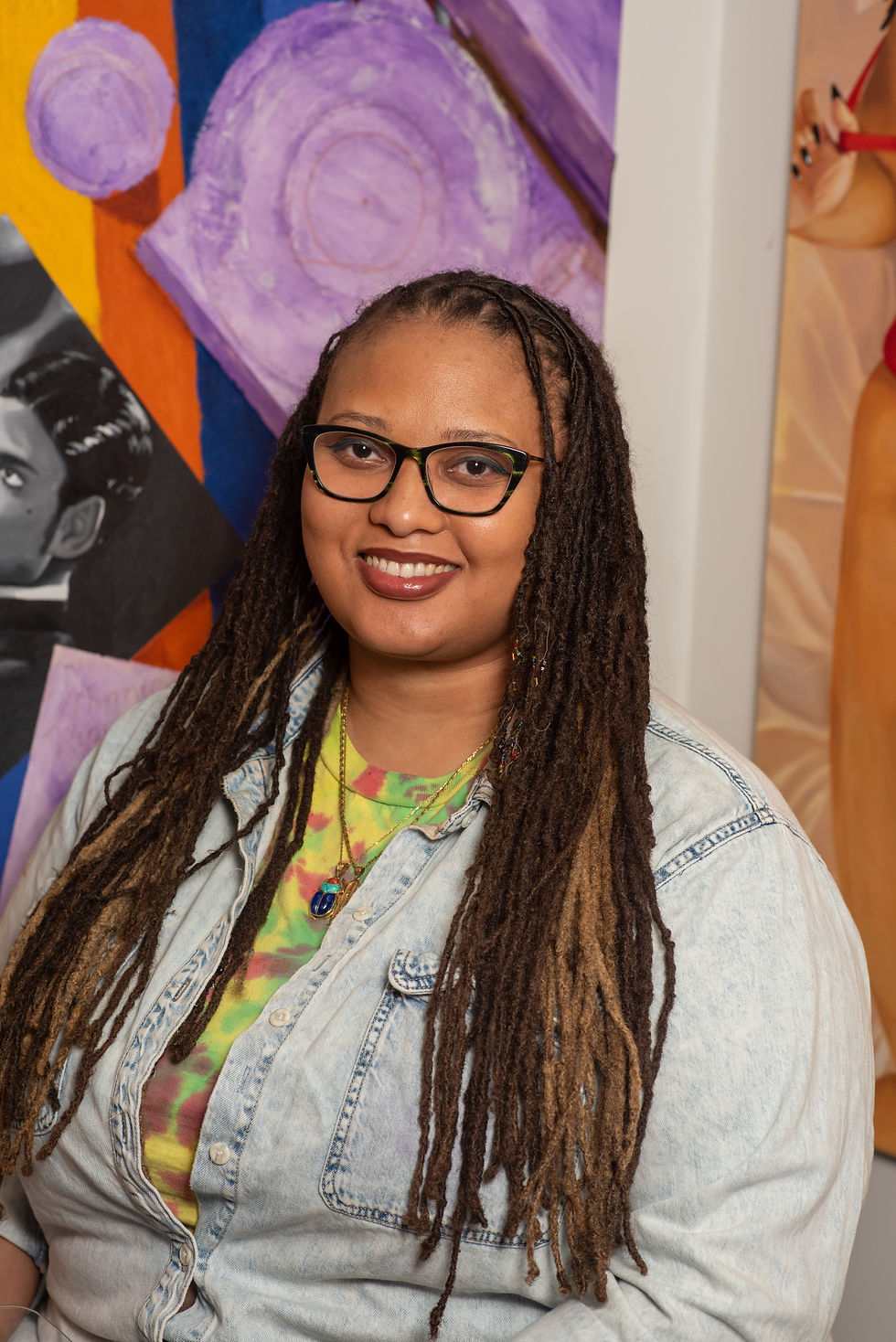
BIO
Egypt Muhammad is a Los Angeles based multidisciplinary artist whose work explores Black culture and history. Working with mixed media and assemblage, Muhammad creates sculptural paintings that invoke intimacy by pulling the viewer in closer to the detail. She uses detail as a reparative form of care her subjects that is palpable to the observer. Egypt has a Bachelor of Science degree from Tuskegee University and is an MFA candidate at Otis College of Art and Design. Their work has been exhibited at The Helen and Abraham Bolsky Gallery in Los Angeles and The Accent Borromini Center in Rome. She’s been commissioned for a mural of Latasha Harlins at The Salteater’s Bookshop and had the artwork later licensed by the Adidas Group. Her work has been recognized by the 2026 Women Painters West Juried Painting Competition. She is currently working on a collection of works inspired by Black photography, music, and literature. She hopes that her community feels seen and heard through her work.

BIO
Tracy Poindexter-Canton is a Spokane, Washington-based mixed media artist whose work explores Black American identity, memory, storytelling, and the intersection of literature and visual art. Drawing on her professional writing background, she creates collage-based works inspired by novels, personal narratives, and intuitive image-making.
Using acrylic, oil pastel, ink, paper, found objects, beads, feathers, and other materials, Poindexter-Canton builds layered compositions rich in texture and meaning. Her acclaimed "To Shalimar series," inspired by the novels of Toni Morrison, led to acquisitions by the Washington State Arts Commission and Spokane Public Library. In 2025, she was selected for a national exhibition at the August Wilson House in Pittsburgh honoring the playwright’s legacy; her work is now part of the House’s permanent collection.
She exhibits nationally and internationally, and is included on the Arte Noir Black Artist, Washington State Arts Commission and Seattle Office of Arts & Culture Public Artist rosters.

BIO
Suzette Royster is a multi-media artist from Philadelphia, Pa currently living in Rockville, Maryland. Her work explores black art, focusing on portraits as a form of self-expression and representational stories. As a black woman in America, her admiration and appreciation for the African American culture has deepened over the years. Suzette's paintings seek to capture and commemorate moments of Black creativity often overlooked in the art world, offering a unique perspective and honest documentation of the lived experience. Ultimately, Suzette Royster brings stories to life, creating visual impact that captivates and inspires.

BIO
Aliyah Sidqe is a Sacramento-based visual artist whose work explores Black womanhood, motherhood, memory, and the beauty found within everyday life. Working primarily in oil paint, she creates intimate figurative paintings that elevate ordinary moments into powerful reflections on identity, care, and belonging.
Drawing from personal experience, Sidqe's work centers themes of softness, vulnerability, and connection, challenging narratives that often overlook the tenderness and complexity of Black femininity. Through richly detailed portraits and narrative scenes, she celebrates the emotional significance of daily rituals, relationships, and acts of self-preservation.
A self-taught artist, Sidqe has exhibited work throughout the Sacramento region, including at the Crocker Art Museum. Her practice bridges personal storytelling with broader cultural conversations, creating space for reflection, recognition, and care.

BIO
Tiffany Steele (Tiffany D. Johnson) is a contemporary abstract and mixed-media artist whose work explores perception, identity, emotion, and the complexity of the human experience. Working primarily in oil, acrylic, and mixed media, she creates layered compositions that invite viewers to slow down, question assumptions, and engage with perspectives beyond their own. Through expressive brushwork, layered textures, and symbolic imagery, Steele creates work that encourages reflection, dialogue, and emotional connection.
Steele studied at the School of Art at Bowling Green State University and continued her artistic training through painting courses at the Toledo Museum of Art and the Brecksville Center for the Arts. Her work has been exhibited throughout Ohio, including her solo exhibition, Life in Christ, at the Bowling Green State University Student Union Art Gallery, as well as numerous juried and group exhibitions. Her artwork has received several honors, including an Honorable Mention at the In Honor of Trees exhibition and Congressional Recognition in the 11th Congressional Art Competition.
After stepping away from her artistic practice for more than a decade, Steele returned to painting with renewed purpose, allowing experiences of growth, faith, and transformation to shape her artistic voice. In addition to her studio practice, she has served as an arts educator and facilitator, leading workshops that use creative expression to reduce stress and anxiety and teaching community-based art programs. She also worked with the Museum of Contemporary Art Cleveland (MOCA), further expanding her experience within the contemporary art community.
Steele’s work is held in private collections in Ohio and New Mexico, as well as in the public collection of the Love Haiti Fund in Fond Batiste, Haiti. Through each piece, she seeks to create opportunities for viewers to question assumptions, embrace multiple perspectives, and engage more deeply with themselves and the world around them.

BIO
Jurnee Ta’Zion is an award-winning multimedia artist, muralist, curator, and creative organizer based in Cleveland, Ohio—the city that raised her and continues to shape her practice. Coming from a lineage of Black artists, she has been immersed in creation and expression from an early age. Her artistic training began at the Cleveland School of the Arts and continued at Cleveland State University and the Cleveland Institute of Art, informing a multidisciplinary practice rooted in self-discovery, healing, and community engagement.
Working across sculpture and three-dimensional forms, as well as painting, printmaking, drawing, and ceramics, Jurnee’s work explores personal and collective narratives while prioritizing accessibility and transformation. Her solo exhibitions include “Life Be Lifing” at Worthington Yards, “B O U N D T O” and “Mind and Matters” at The Galleries at CSU, and a featured exhibition at Loganberry’s Annex Gallery. She has also curated group exhibitions such as “H.A.L.O.” at Create-A-Space, and “ashes to ashes.” in collaboration with DeepRoots and Literary Cleveland. Her work has also been featured in regional and national exhibitions, including DeepRoots’ “The Nature of Healing” at the Cleveland Botanical Garden, at DCDG & Co’s "Iconic Visions" Girlfriend’s 25th Anniversary Exhibition in Los Angeles, and many more.
Across disciplines, Jurnee remains committed to serving her city in as many ways as art and creation allows. Her public art and mural work include projects with Impart 216 (with the mural “From Many, One Hive.”), Christa Freehands and LAND Studio (with a mural currently being created in her neighborhood of Buckeye), and more. In arts administration and advocacy, she has worked with organizations like Assembly for the Arts and served as a Fellow for Neighborhood Connections’ Arts and Culture Network Nights, helping connect artists to resources and strengthen Northeast Ohio’s creative ecosystem.
Beyond visual art, Jurnee has been active in performing arts, including poetry, singing and acting, with performances such as Songs for My Sisters with Cleveland Public Theatre and participating in poetry groups and events around the city. Her goal is to give back to the community that shaped her while sharing with the region and the world that art holds the power to transform and enrich lives.
BIO
Larissa Umulinga is a Rwandan-born, Seattle-based photographer, curator, and creative founder. Her work spans editorial and portraiture, drawn to the faces, stories, and textures that define a community's identity. In 2025, she founded wthnreach.co, an initiative dedicated to discovering and amplifying artists within their own communities. In January 2026, she curated In Your Backyard, Wthnreach.co's inaugural exhibition in Kigali, bringing together eight artists across photography, mixed media, and figurative practice and earning independent editorial coverage from Imigani, Kigali's leading cultural platform. Through Wthnreach.co, she is building Corner, a monthly series documenting the artists and cultural workers shaping the places they call home.

BIO
Brenetta Ward is a Seattle-based fiber artist, third-generation quilter, and oral historian. Her work has been exhibited at the Postmark Center for the Arts; Stark Museum of Art; The James Museum of Western & Wildlife Art; The Textile Center; National Afro-American Museum; Ethnic Heritage Art Gallery; Tacoma Art Museum; Northwest African American Museum and Spellman College Museum of Fine Art. Selected pieces have been published in We Are the Story: A Visual Response to Racism and Spirits of the Cloth and included in public, corporate and private collections. As a fiber artist, she believes quilts have the power to nurture our spiritual needs for creativity, beauty and comfort.