
LEATRICE ELLZY AND THE NATIONAL BLACK ARTS FESTIVAL: NEW LEADER, NEW VISION, NEW REASON TO HEAD TO ATLANTA IN 2027

Updated: Jan 22
by Leilani Lewis
In 2002, Leatrice Ellzy was handed a folder with her first major assignment for the National Black Arts Festival: produce a tribute to the Negro Ensemble Company. She'd never heard of it.
"Mind blown," she says of the research that followed. "A Sam Jackson, a Denzel Washington, Phylicia Rashad. All these people that I grew up watching. They were all in this NEC."
The Negro Ensemble Company had launched careers and shaped Black theater since 1967. Ellzy spent months tracking down former members of the disbanded company, assembling scenes from plays like A Day of Absence, pulling together a panel moderated by Tony Award-winning director Kenny Leon. Robert Hooks, Gerald Krone, and Douglas Turner Ward, the NEC's three co-founders, told stories about starting the company, teaching classes in a New York apartment, knocking out a bathroom wall, and using a bathtub as a staging ground. Ward, the playwright and actor who had been the company's artistic director for decades, cussed so much that Kenny had to remind him there were kids in the room. ("Oh, damn. Shit. Okay," was the response to the audience’s laughter.)
At the close of the mainstage performances and tributes, and after a standing ovation, Ellzy asked any other NEC alumni in the audience to stand.
A third of the house rose.
"I welled up in tears," she recalls. "It was like homecoming for these actors, writers, stage managers, and production people. That was a powerful moment of understanding why Black art deserves its own space. The history was just so rich."
"There Is No American Song Without Our Verse"
The National Black Arts Festival was a radical idea in 1987. When Michael Lomax, then chairman of the Fulton County Commission and now president of the United Negro College Fund, put out a national call in 1986 asking whether such a festival was needed, the answer was unanimous: Yes. And it needs to be in Atlanta.
Atlanta had what it took. HBCUs where W.E.B. Du Bois had walked, and Hale Woodruff had painted his murals. The cradle of the civil rights movement. And crucially, Black people in positions of power. In government, in corporate leadership, in the foundations that could fund the thing.

The festival was an invitation to writers, visual artists, theater makers, dancers, and musicians. A gathering place for Black artists from across the country and the world to converge on Atlanta every July. A space to see work, communicate, collaborate, and find your tribe.
The first festival expected 50,000 attendees. A million people showed up. Maya Angelou came. So did Nikki Giovanni, Sonia Sanchez, Cicely Tyson, and Harry Belafonte. They kept coming back, not just as performers but as supporters.
"Every artist of a particular age in Atlanta has a National Black Arts Festival story," Ellzy says. "They say, 'I became an artist because I went to NBAF and understood that this is something I could do for my life.' The bar was set. And that bar was artistic excellence."
From 1988 to 2012, the festival operated at full scale, first biannually and then annually. In 2014, the model shifted. For the past 12 years, NBAF has focused on community engagement, emerging, mid-career, and seasoned local artists, and arts education in schools. No summer festival. But deep roots in local programming.
Now Ellzy has returned to reshape the organization.
Ellzy's path to the National Black Arts Festival wasn't direct. She moved through Girl Scouts, the YWCA, and public broadcasting, where she became what she calls "the pledge queen," raising over a million dollars for Georgia Public Broadcasting.
But the arts kept calling. In 1998, a friend insisted she apply for a job at the Woodruff Arts Center. That same day, construction forced a detour right past the building. She stopped in, talked for 20 minutes, and was offered the job on the spot.
A year later, she was planning collaborative programs for Woodruff's participation in the 2000 National Black Arts Festival when Stephanie Hughley, the festival's founding artistic director, took notice. Hughley opened a door: "You need to come on over here. We need you at the festival. We need you."
She's been connected to the organization ever since.
Ellzy is old enough to have parents who marched in the civil rights movement. Young enough to have lived through every evolution of technology. She calls her generation "the bridge."
"We know where we've been, but we also have this vision for where we're going," she says. "Part of my success was being able to speak to the past because I understand the importance of a Maya Angelou, but I'm also looking at this dope group of artists that are coming up, who are my peers, my contemporaries."
This showed up in her programming. When she produced a tribute to Curtis Mayfield, she wove together Eddie Levert and The Impressions with Atlanta-based jazz trumpeter Russell Gunn, actress Jasmine Guy, and singers Van Hunt, Joi, and Dion Farris. The result was a multi-generational audience united by artistry rather than age.
Under her leadership, her team was live-streaming from the park in 2008 and had an app for ticket purchases before most people knew what an app was. "I've always been tech-forward," she laughs. "Although Web3? I'm older now. I need my young people to help me navigate that space."
After a decade at the festival and out in the field, Ellzy took on the role of Executive Director at Atlanta's Hammonds House Museum. Visual arts only. She loved it, but by year four, she was missing performance.

Then the Apollo Theater called. She was hired in February 2020. She planned to be totally moved to New York by May. Then the pandemic hit. On her birthday.
She continued to run Hammonds House and operate in her new role for a year before fully transitioning. "I care about Black institutions," she says. "If I have the strength in my body, I'm in it."
But the Apollo. The stage where Ella Fitzgerald won Amateur Night at 17. Where James Brown recorded Live at the Apollo. Ellzy stepped onto it for the first time and felt it.
"We know where we've been, but we also have this vision for where we're going," she says. "Part of my success was being able to speak to the past because I understand the importance of a Maya Angelou, but I'm also looking at this dope group of artists that are coming up, who are my peers, my contemporaries."
"You could literally feel the energy of everybody who had left it all on the stage," she says. "All these years of Amateur Night, where people came every week and left all their hopes and dreams. Then the superstars. The Motown Revue, James Brown, everybody. It was exhilarating. Breathtaking."
As Senior Director of Programming, Ellzy worked alongside Executive Producer Kamilah Forbes to shape the Apollo Theater’s artistic vision. She learned how to lead differently there. How to hold space for a team, work with unions, and commission work differently.
She beamed about one particular piece she commissioned, "The Blues and Its People," a journey through Black music anchored in poet and critic Amiri Baraka's landmark 1963 book Blues People, composed by jazz trumpeter Russell Gunn. The piece featured Gunn’s 25-piece orchestra, which featured jazz vibraphonist Stefon Harris, vocalist Jazzmia Horn, the legendary Oliver Lake, and Tony-nominated actress Amber Iman as narrator.
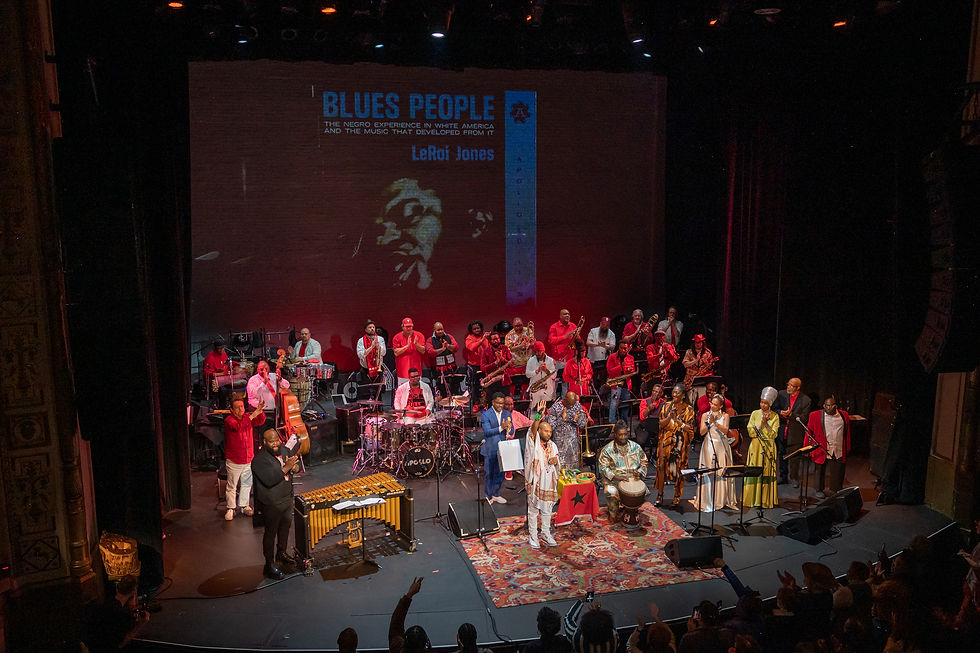
"Baraka's book really only covers up through bebop," Ellzy explains. "So Russell and I were thinking, if we brought a through line, where would Amiri take it? Russell was really into hip-hop. So we decided to bring Jessica Care Moore." The result was a journey from spirituals to New Orleans to bebop to hip hop. "People were blown away," she says. "It's a powerful piece."
It’s a new beginning for NBAF and for Ellzy, who knows exactly what she's building. "I'm not trying to build the National Black Arts Festival of the past," she says. "The language now is artists and creatives. The conversation isn't just about artistry and skill. It's about commerce, about manufacturing, about the creative sector as a driver of revenue and resource development."
The original festival centered on music, theater, dance, film, visual arts, and literature. Ellzy wants to expand that. She points to a recent program featuring furniture designers. The organization will continue building residencies for young people in fashion design, music production, and photography. A fall program examining AI technology through the lens of Black creativity is developing in partnership with Spelman, Georgia State, and Georgia Tech.
The 2026 programming examines 250 years of America through the lens of Black creativity. "There is no American song without our verse," she says. "That is how we're approaching it."
For 2027, she's planning a return to the summer festival model with a rolling start of visual arts, film, theater, and an event she's rechristening "Legends and Luminaries," honoring both established masters and young creatives already doing extraordinary work.
"At a pivotal moment when Black culture faces both threats of erasure and increasing commodification," she says, "it is more critical than ever that we nurture it with intention, creativity, and sustained investment."
In Ellzy’s speech and storytelling, one can feel her deep, consistent reverence for the past, and the people whose shoulders she stands on, works alongside, and brings into the new vision of the festival.
In 1988, a 20-something Ellzy drove down to Atlanta to visit her boyfriend and stumbled into the first National Black Arts Festival. She called her parents: "There's this thing in Atlanta called the National Black Arts Festival. There's Black art all over the city. It is so cool. If they met me, they would want to hire me."
Years later, when she got the job, her mother reminded her of that conversation. Turns out she was right.
More information about the festival can be found here. The Festival is slated to take place in July 2027; see the website for updates.
ABOUT THE AUTHOR
Leilani Lewis is a Seattle-based writer, cultural strategist, and community builder. Her work explores beauty, resistance, and radical mischief. Find her wherever conversations about art and liberation unfold.


Comments