
PRETTY THINGS & UGLY BUSINESS: CARLETTA CARRINGTON WILSON'S OBJECT LESSONS
Updated: Aug 31
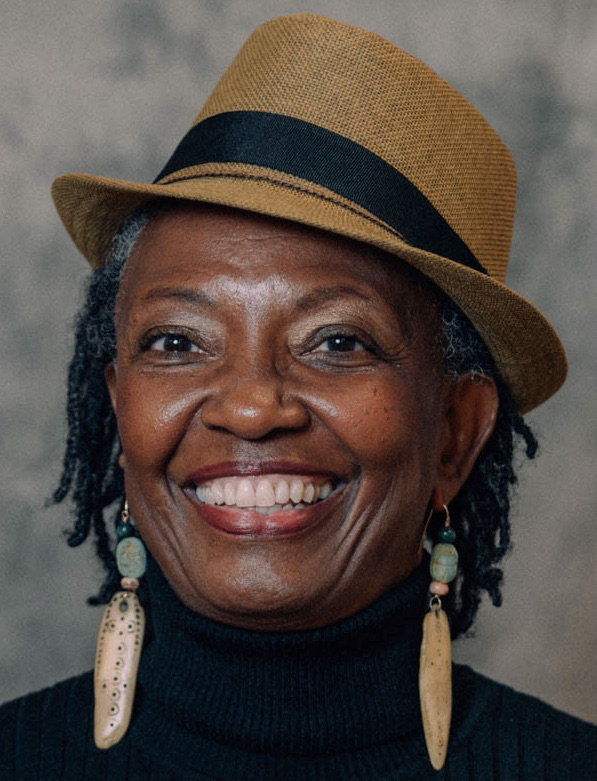
By Charlotte Watson Sherman
Garlands of vibrant flowers dangle inside the Bainbridge Island Museum of Art’s (BIMA) two-story Beacon Window Gallery. Faux green leaves fastened to gold sequins spell: UTOPIA. The curved window juts into space like the bow of a ship. I am here to view Carletta Carrington Wilson’s Object Lessons. Wilson, a multi-hyphenate visionary, uses “history as canvas, an eye, camera lens, brush stroke, sculpting tool, pen and thread.” Despite strands of petals and pretty, Wilson’s show will ferry you past unattractive truth.
BIMA describes Wilson’s work:
Carletta Carrington Wilson merges poetry, collage, and installation to explore memory, ancestry, and the power of objects. Based in the Pacific Northwest, she uses fabric and found materials as portals to the past, linking personal and collective histories. Her work reclaims generational knowledge through image and text, navigating time, identity, and place.

Object Lessons asks us to contemplate the Black body, stolen, chained, marched to the coast, jailed in castles and forts, sold, then sailed across the deep in ships with names like Desire. Followed by the centuries-long nightmare of plantations. Wilson’s work requires us to think deeply about human beings who did not possess the right to own their own bodies, or the means to tell their own stories.
Wilson instructs by utilizing layered fabrics and pretty, shiny things, each work fashioned with painstaking detail and includes images from records of the trade in cotton, tobacco and stolen negroes. The kidnapped, only documented by number, have no names. Who tells the story of human cargo? What lessons can we learn from the erased?
Wilson’s collages, assemblages, installations, and altered books shed light on the inner lives of the enslaved. Series after evocative series weave a visual narrative about cotton and the role Black bodies played in shaping the global economy by picking that cotton for free. Wilson avoids images of despair; she fabricates embellished works of art that embody the beautiful struggle.
“My fingers move across silk, wool, gabardine, mohair, brocade, chiffon, crepe, seersucker, cotton. Sometimes the cloth is solid, an occasional stripe, but mostly, and foremost, floral.”
Relegated to “negro cloth” (aka slave cloth, cheap coarse fabric made in Northern textile mills for mandatory dress of the enslaved), the finery Wilson uses – her mother’s lace, thrifted silk and sequins, cloth that shimmers and shines – could not have been worn by an enslaved woman. It was against the law for them to wear it.

You first view Wilson’s self-described “decorative art with a message” in BIMA’s Beacon Gallery. Minstrel See, a mixed-media collage, embeds text and minstrel images to invite viewers to “step up” and “view natural folk.” Images intended to degrade Black folk are transformed by Wilson’s skillful fingers and sorcery. Bling lessens the sting of those watermelon smiles.
Wilson is particularly driven to explore the history of unknown women. The Maid’s Story is an altered book that highlights the labor of Black women – the cleaning woman, washwoman, servant; Black women often voiceless, invisible and erased.
“This work is in honor of my mothers, great and grand, as well as my birth mother. Before them, however, are my enslaved ancestors who labored in cotton fields, and before them I lay claim to the deep interior of Africa from which they came, where cotton grew into trees… Cotton binds me to them, the sharecroppers, quilters, washerwomen, seamstresses, and pieceworkers making more than their quota on industrial sewing machines.”
An untitled installation reveals how the cotton trade impacted women of all classes of society – enslaved, poor White, even European royalty. Women are sandwiched inside a caged space, a suffocating canopy of cotton overhead, a sea of it beneath their feet. Antique keys dangle from hooks. A crowned rooster sits at the apex. All are captives of the trade.
On the walls, multi-ethnic peoples of the world form letters that spell: UTOPIA. A perfect place.
Except here, Wilson considers Sir Thomas More’s Utopia (1516), an ideal place where private property and money have been abolished in a classless society that allows slavery.
Not so perfect for those in an untitled assemblage “weep-ing weep-ing weep-ing” from the agony of families torn apart, never to see each other again.
“I see the plantation as a Utopian landscape…”
A found table with a top shaped like an antiquarian book is crafted into Utopia: When You Get There, Remember Where You Came From. Wilson again “works” minstrel imagery to remind us of the many enslaved men and women who resisted their chains. “Dem Step March Walk Run Away.”
At the heart of the floor-to-ceiling scroll-like lessons of possessions is Wilson’s lace-framed titular poem:
…for the essential lesson of a possession
is to be/be possessed grasped handled
carried off tracked down traded
given away inherited gifted sorted
exported income for someone…
The toile of the mixed-media textile evokes romanticized European mythology and, as Billie Holiday sang, “pastoral scenes of the gallant South.”

This retrospective exhibit continues inside the Feferman Gallery. So much beauty to behold.
kNot free kNot human explores the limbo in which captured Africans found themselves once trapped inside society’s classification – unworthy of freedom; devoid of the impulse to resist captivity, considered creatures without a soul in order to justify inhumane treatment. However, there was always resistance to slavery, always someone, somewhere plotting to escape. Wilson “worked up” the image of the Black body in flight via runaway slave advertisements in an artist book, prints and posters, collage, and mixed-media.
“The figure of the fugitive ‘advertised for capture’ appeared in 17th, 18th and 19th century newspapers in the states, the Caribbean and as far flung as Brazil and England. Each escape was symbol of and testament to an unceasing resistance perpetuated on all sides of the Atlantic.”
The enslaved were bestowed slave names by their captors; their true names could not be spoken. Even after slavery, unable to read or write, most of the newly freed could only sign their name with an X.
“The idea is that once a person became enslaved, their lines of descent are knotted. Each time a person is sold, with each name change and change of place of bondage, the loss of knowledge of familiar ties becomes, increasingly, knotted and unknown.”
letter to a laundress is an installation of 26 photographs printed on canvas and attached to fabric. The images hang on a winding clothesline above our heads and support the show like a spine. Here, Wilson honors the labor of those women who “took in wash” in order to survive. Laundresses and washerwomen like Wilson’s great-great-grandmother, to whom she pens an epistolary poem written in blue across the photographs.

Wilson had an epiphany that some of these women likely did laundry for men who lynched a loved one.
oh mothers, mothers mothers of blue, blue waters
who hung from those knotted lines
Wilson’s work is a journey into the past; yet “the past is not even past.” There have been dozens of recent suspected lynchings across the United States. Dirty, ugly business.
Wilson does not flinch from this ugliness. She uses pretty things to help us absorb the horrifying.
constellation of shadows & leaves uses the natural world and collage materials such as antiquarian maps, charts and legends along with bejeweled fabric, beads and chains to represent the inner landscape of the kidnapped.
An altered accordion book, Merchant Love, highlights the names of slave ships: Delight. Nymph. True Love. Lamb. Desire.
“Is not the body a book?”
Wilson’s artistic power is on full display in book of the bound. The titular book is a hefty tome encased in intricate layers of fabric, ropes and broken chains. The final book in the series, abduction, is an altered encyclopedia covered in lace, text and small bones to memorialize those who did not survive the terrible journey of bondage; a trail that stretched from Africa to the Americas.
“How did they survive?”
Wilson studied race-based chattel slavery for decades. She turned to slave narratives and found solace. The formerly enslaved treasured the night sky and stars. Rainbows and plants. They found comfort in the miracle of nature.
An object is a door. A way into the way back. It opens the past and I step through that portal. This is not a new, unusual or unique way to work. In the absence of generational knowledge, the imagination creates a past that serves as a link to retrieve what has been lost.

Carletta Carrington Wilson is a library. An ancestral archive. A gifted teacher. Listen. Look closely. And learn.
You can meet the artist at the Bainbridge Island Museum of Art, August 26, 2026, 11:00-1:00 p.m. in the Feferman Gallery.
You can also view the film about Wilson’s work, Migration of the Seebound Heart. Wilson will be on hand for the screening and panel discussion on September 13, 2026, 2:00-4:00 p.m. in BIMA’s Frank Buxton Auditorium. She will be joined by collaborators Lauren Dudley, Whitney Bashaw, and Bubba Jones from Trial and Error Productions. An audience Q&A and reception follows.
Object Lessons closes September 20, 2026.
ABOUT THE AUTHOR

Charlotte Watson Sherman was born and raised in Seattle. She writes for readers of all ages;
her latest, LEARN BABY LEARN: THE SHINDANA TOY FACTORY’S LEGACY OF BLACK PRIDE (Reycraft Books, 2026).


Comments