
WITNESSING THE DOCUMENTATION OF BLACK HISTORY
- Zola Mumford
- May 27
- 13 min read
By Zola Mumford
"It may be lonely. Certainly painful. It'll take time. We've got time. That of course is an unpopular utterance these days…But we do have time...Not all speed is movement." - Toni Cade Bambara, African American feminist author and activist, from “On the Issue of Roles” in The Black Woman: an Anthology (1970).
I was lucky to spend this year’s Mother’s Day with my beloved Mom, Esther Hall Mumford, a historian, author, and compassionate listener. She and my equally beloved, late father, Donald Mumford, had a good marriage because they were good friends and, crucially, history enthusiasts. Both of my parents survived growing up under segregation in the 20th-century Jim Crow South. Their families valued education; both of my grandfathers were part of the war effort during WWII, serving in the Army and Navy, and both knew how to raise livestock and, like my grandmothers, manage rural life at a step below small-scale farming. Sometimes the stories that elders told about the cruelty enacted upon Black lives were hard for a child to hear; I had to grow older to find the joy and bravery in their stories and the histories of people I never knew, but can learn from. Trust me, I like the present and its technology, clean water, a ready food supply, good legislation -- but I often think of the value of history.
Our family began a new life in Seattle in 1975, a Navy family that had cycled through Japan, the Pacific Northwest, and Southeast Asia (U.S. military personnel and civilians would evacuate Saigon on April 30 that year). My father, a Naval Lieutenant, remained in service for several more years; there would be more travel across the Pacific and U.S. states for all of us, but this is not that story.
All mothers do some form of work inside and outside the home. Mother lived in Seattle during the 1960s, drawn by the presence of a relative and a college transfer to the University of Washington. She was a member of the Seattle Chapter of the Congress of Racial Equality (C.O.R.E.) Back in Seattle, she put her political science degree to work in April 1975 as an interviewer, conducting research and interviews with members of Seattle’s pre-1940s African American community for an Oral-Aural History program of the Washington State Records and Archives Division. The program was housed in the Center for Urban Studies in a building on Yesler Way.
Sometimes I was there after primary school, reading and drawing pictures as I waited for Mom to finish work. All kinds of people moved through the open office space in the building, which looked like it came from the turn of the century and had its interior partially remodeled in every decade since; in the 70s, there was a blend of burgundy furniture, 1950s wooden chairs, and 1960s steel desks with drawers that rattled if you slid them open during a furtive search for candy. Most of the people (researchers, writers, a photographer-violinist) seemed artistic and easygoing, aside from one White woman who burst out: “You’re too quiet! Children are supposed to make noise. You sit there reading, or you’re creeping around. Why are you so quiet?” This was an unanswerable question for me; I already knew that some people thought Black people were too loud. Afraid to reply, I sat frozen until she left, annoyed. But most of this glimpse into the work of research had high points. Sometimes working parents have to take the kids along, and the places that we went included libraries, archives, and oral history interviews.
All mothers do some form of work. Inside and outside the home.
Mother Writes of Common Histories
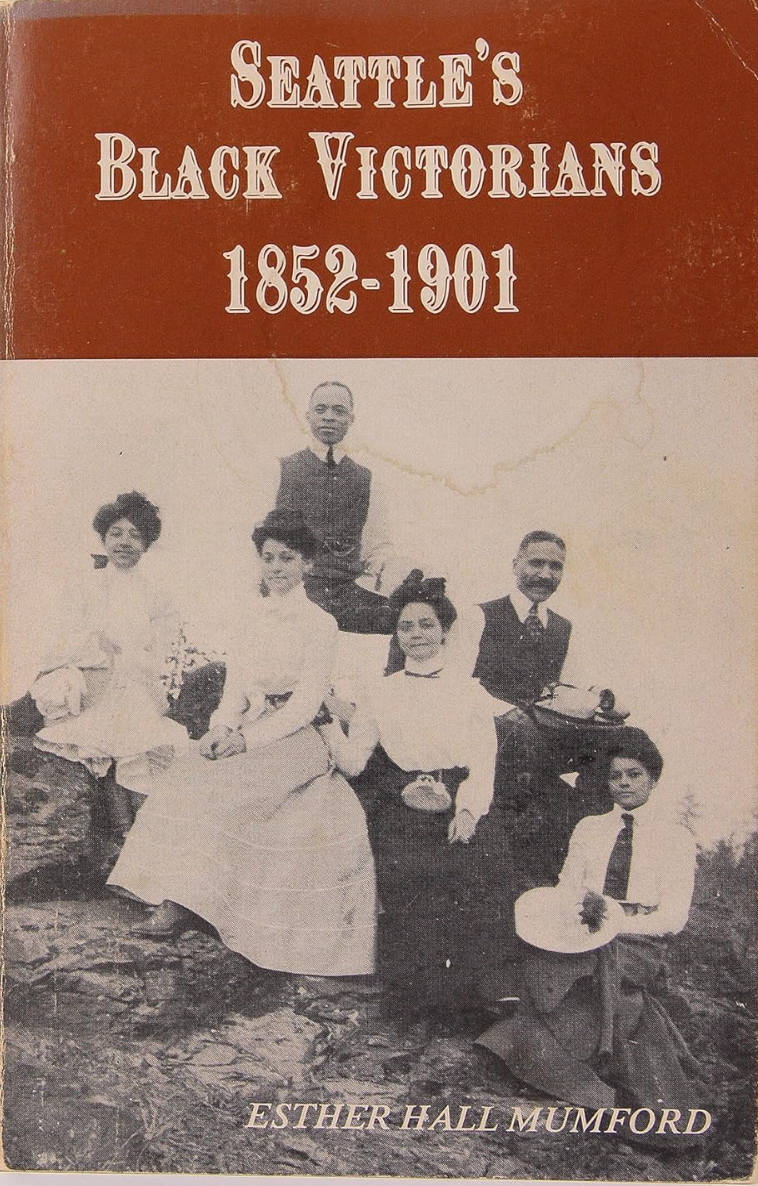
As Mom wrote in the preface to her first book, Seattle’s Black Victorians: 1852-1901:
“One of the original aims of the (WA State Archives) project was to share the story of the common man, Black, White, Filipino, miner, logger, and shingle weaver, with the public. But in December 1976, the program was terminated with its work only about half done. As the years pass and more of the interviewees pass with them, their personal view of history becomes more precious.”
After careful thought and discussion with my father, who was always supportive, my mother decided to continue the research and write a book. Her research included interview transcripts, historic newspapers, census records, property transactions, bills of sale, chattel mortgage records, church registers, and family scrapbooks. She was able to trace the first Black person settling in the area to 1852, a year before Washington was declared a territory. His name was Manuel Lopes; he was a sailor from New Bedford, Massachusetts. Maritime work brought other Black men in those early years: “Philip J. Francis worked his way up from Jamaica, stopping first in Oregon, and ex-Navyman William Grose moved to Seattle after working on the mailboat Constitution, which sailed from Victoria to Olympia with intermediate stops at Seattle and Tacoma. (2)” Black women and Black families arrived more frequently in the region following the completion of railroad lines.
After no publishers showed interest, the decision was made: self-publishing, which was challenging in those days. We were frugal people without generational wealth, but somehow my parents did it. Writing on lined legal pads of yellow paper that became standard items in that home and now mine, they created a small business: Ananse Press, publishers of history and culture. Over the years, I accompanied my parents to many events, fairs, and festivals, traveling with display stands, colorful table cloths, and folding tables. By the time I was a teenager and learned of the punk D.I.Y. ethos, it felt familiar because I’d spent so many years in Black communities around people who had more ideas and work ethic than they had funds, and they knew how to make things happen. After all, they’d been doing one version or another of D.I.Y. for 400 years.
Ananse Press published several books. The first four listed below are by Esther Mumford:
Seattle’s Black Victorians: 1852-1901 (1980, out of print);
Seven Stars and Orion: Reflections of the Past (1986)
Calabash: a Guide to the History, Culture, and Art of African Americans in Seattle and King County, Washington (1993);
and The Man Who Founded a Town (1990), a children’s book about the George Washington Bush, founder of the town of Centralia, Washington.
Mrs. Mumford also edited and published Older Than My Mother, a breast cancer memoir by Augusta Gale and The Story of Coffee, written and illustrated by Seattle artist, Sultan Mohamed


All history requires some degree of fieldwork. If you can’t travel to a place, you have to stretch your thinking enough to at least imagine being present in the place occupied by the people you study. When I was growing up, sometimes fieldwork was a family activity. Mom in archives and libraries. Evenings spent at Suzzalo Library (where I would read copies of Godey’s Lady’s Book) and Special Collections on the UW campus. Visits to the local National Archives and Records building with Mom and Dad. Lots of driving to various county offices with my parents and brother, or just my parents and me, depending upon activities (children were slightly less scheduled in those days). I don’t remember how old I was when I would first be given a research task during field visits, but I enjoyed it. Receiving the name of a person, I would carefully search the rows of faded ink cursive writing in a record book or other local government document. Often, these primary sources were dated in the late nineteenth or early twentieth century. The form and appearance of these sources was fascinating: marbled end papers, aged covers with gold-stamped titles, real leather bindings or crumbling mock leather. We attended public programs presented by librarians and archivists to see rare books and documents in collections.
Occasionally, someone that Mom interviewed trusted her with the loan of their family photos, which my father photographed using a 35mm camera and various types of copy stands. Dad set up a dark room in the basement of our family house; he purchased some of the equipment before leaving Japan, where he had beenwas stationed as a Navy Lieutenant. Observing Dad’s careful handling of cartes de visite, also known as cabinet photos, and other photographic prints sparked my interest in photography and film. These early images of Black people showed strivers as they wished to be seen: carefully styled clothing and hair, chins lifted and faces calm for the long exposure times required by the photographic technologies of the period. Such images presented real-life counterpoints to the old (now “vintage”) cartoons and old movies with blackface sequences on after school and weekend television. Sometimes I met the children and grandchildren of these dignified and gracious people when Mom took me along to an oral history interview -- I knew that our world of strivers, educators, thinkers, dreamers, and creators was a real world. Even as a child, I quickly learned the differences between stereotypes and the many different realities that Black Americans built for ourselves. Now people just call those multiple realities subcultures, and you can scroll through social media posts to see hints of them. There are so many different Black social dances, music styles, slang, visual arts, hairstyles, businesses, charitable efforts -- always evolving, like those people of a hundred or more years ago..
Having seen so many examples of the intellectual and aesthetic value of archives during childhood, I was excited by the possibilities of digitization and online archives as the internet grew in the early 1990s: more access, more wonder, more information could be accessible for everyone.
Nothing was easy about Mom’s writing life. Once I came home from school to learn that she had fainted while doing research at the downtown Seattle Public Library, exhausted by managing a household, raising children, taking temp jobs, and maintaining a loving, occasionally transPacific Navy marriage. She wasn’t injured but it was sad and frightening to think of her in such a vulnerable situation. Although her research focus involved the time period before the 1930s, some people told her that they would not buy her books (or support a grant application) because their families were not named in them -- even when their families had not settled in Washington until the 1940s. As a kid accustomed to Black history that included 18th and 19th century figures such as Benjamin Banneker, Phyllis Wheatley, Harriet Tubman, and Frederick Douglass -- none of whom I was related to, but found inspiring -- this rejection felt strange to me.
It wasn’t possible to include every single person’s name and story. If my mother had had the funds, time, and support (both of my parents always worked), she may have been able to expand her research or collaborate with others. When the late Dr. Quintard Taylor published his books and founded BlackPast.org, Mom was happy to see his work published and spoke admiringly of his research and mentorship of students. I saw them have friendly conversations at events; their work was similarly themed but different, and it was fine. There is still so much to be learned, published, and said about Black history in America that there is room for all researchers contributing to shared knowledge and the common good.
Mom’s work was plagiarized or otherwise excerpted or referred to without credit; we knew because a family member or friend told us (“I took this out of the newspaper because they mentioned Black Victorians, but didn’t mention your name or book,” my great-aunt said on yet another. An image from the book was slightly visible in the photo of the student that had used it; no attribution).
A person whom Mom respected for her hard work and community connections published a short article in a Black community newspaper that included, “Esther Mumford did not write the history of the Central Area. I wrote the history of the Central Area”. My mother had never claimed to have written the history of the CD, and reading her work would have made it clear that Mom used interviews, primary source research, site visits, and data to write about when, how, and why Black people came to Washington; the work they did; and how they formed communities. Reading the accusation hurt my feelings, because it was so far from the truth -- history was always about the “we”, not about “me” for my mother and father and I assumed that other Black people felt the same. When we thoughtfully study the past, we can gain encouragement, strength, and compassion for ourselves and others. The woman’s comment also ignored the 19th and early 20th century time periods that Mom typically studied. Unfortunately, I wasn’t sure how to talk to the woman about my concerns so I let it go. She has since passed away and now I can never have the conversation. *
Part II
From Writer to Readers and Your Own Histories
Selling the books during the pre-internet era wasn't any easier. Many sales came from atop the previously mentioned folding table or word of mouth. Frequently, shops would not carry any of the books at all; some were soft refusals, in which the lack of response was itself an answer. Dad always told me, “Life is not fair”, but it was hard to separate emotions from my observations, because I had seen firsthand Mom’s years of hard work, effort to document and verify, and an effort to be honest and objective. Of course, I know that many writers and artists know this pain. You continue to do the work because it is meaningful to someone, and you don’t always get to know who, where, or why.
Although she was never a member of college or university faculty, Mom gave many lectures and presentations during the 80s and 90s. They joined a work party that cleaned plant overgrowth away from the graves of Black miners in Black Diamond. My parents joined the Black Heritage Society of Washington at the time of its incorporation in 1982. Sometimes she and Dad drove to locations far from Seattle, invited by members of progressive-minded historical associations, Black Student Unions at universities, churches, or other organizations.
After one well-received presentation to a historical association in a semi-rural, mostly White part of Washington, two of the hosts politely offered to escort my parents by car to the main highway. Yes, they understood that Dad had a map. It was just that they wanted to ensure that my parents got through the area safely. They didn’t explicitly state that people in the area might enact racist violence, but as Black Americans of a certain age my parents had honed the survival skill of interpreting unspoken words. So they formed a small, brief caravan: one car in front, leading the way and watching out. Black folks in the car in the middle. One car behind, close enough that no one else could follow the middle car. At the exit, their hosts pulled over and waved, still watching.
I never met these people, but for years afterward, I said a prayer of thanks for their kindness and honesty whenever I thought of them. Racism was not absent in those years between Dr. King's assassination and President Obama’s service in office. Truly hospitable, these rural historians were willing to be physically present to help. This near-incident, and similar moments of risk or indignity over the years, felt like parables to my younger self. I tried to be equally considerate of others when I could. Sometimes I gave someone a ride, or watched or asked to make sure a person was safe.
What did I learn as the daughter of my Mom, the historian and writer and my Dad, always supportive as a collaborator and photographer? The writing life is a hard life, but I think that Mom drew strength from hearing interviewees’ stories and from the surviving pieces of information about those ambitious, hard working people that came to Seattle before WWII. The interviews, photographs, and documents told me that people had faced bigotry with hard work, resistance, political organizing, community activities, and spiritual strength. Maybe people want the same essential things in every century: friendship, kindness, safety, love.
Seattle’s early Black residents now have their names acknowledged by organizations such as Africatown (the William Grose Center), the ongoing educational and archival work of Stephanie Johnson Toliver and the Black Heritage Society of Washington, and other historians and community groups. For decades, the annual Roots Picnic has kept alive the legacy and contemporary reality of the descendants of early Black families. Please forgive me, readers, if I left your family out while writing this -- it isn’t intentional, and your story deserves its own research. People with connections to Seattle’s Central District, Seattle’s Rainier Valley, Pasco, Bremerton, and other locations know that there’s too much information about the Black presence in the Pacific Northwest to fit into one blog post. Decide to tell the story and get started. Interview family and friends. History can be an active thing when we use what we learn to reflect upon our own lives.
Archives and libraries were good childhood experiences for me. As previously stated, some of the primary sources that my mother used in her research included microfilm reels with full-text images of early Black newspapers. Here is a suggestion for an activity to try with young people in your family or community.
Chronicling America: Historic American Newspapers (https://www.loc.gov/collections/chronicling-america/about-this-collection/ ) is a fascinating collection of 18th - 20th century American newspapers, managed by the Library of Congress. The collection includes newspapers from different ethnic communities in various languages.
Prepare a short research plan.
Write down search words and phrases related to what you want to know. This list may include names, addresses, or churches or organizations, for example. If you’re researching Black history, use historical terms and synonyms (Negro, Colored, Afro-American) and swap these out in separate searches. You will have to try different word combinations.
Use Advanced Search to choose a location: a U.S. state or territory.
Choose an African American newspaper, again using the Advanced Search filter; use the “Ethnicities” option. Search Washington state or choose a newspaper from a state where you were born, lived previously, or are interested in. Write down the names of the newspapers so that you can return to them later.
Start your search. Try searching a full name, surname, or street address for your home or a place that you like to go. If you don’t get results on a full name, try placing both names inside quotation marks (“Horace Cayton”) so that both names appear together.
Review the entire page of a newspaper from your search result. Skim the text and photographs -- you don’t have to read everything unless you want to.
4) Talk to the people with you about what you found.
What do the advertisements, letters to the editor, and news articles tell you about Black life in early 20th century Seattle/the United States?
Did you notice articles from World War One or World War Two? Some newspapers will have announcements of events intended to welcome or offer support to soldiers. Are there military veterans in your family? Has anyone in your family ever talked about their experiences?
In most historical Black newspapers, you will see some news reports (from national Black news organizations) about things that Black people accomplish or have experienced around the U.S. or other countries. What stands out to you? Imagine discussing these stories with friends if you lived during those times. How might that change your view of the world?
National Archives of the United States: Genealogy Activities For Kids. Includes a printable family tree activity page for blended families.
National History Day: Guidelines for Conducting Oral History Interviews
Oral History Best Practices - Oral History Association. Learn about the importance of professional-level preparation, interviewing, preservation, and access.
Esther Hall Mumford’s published work includes:
Seattle’s Black Victorians: 1852-1901 (1980, out of print);
Seven Stars and Orion: Reflections of the Past (1986)
Calabash: a Guide to the History, Culture, and Art of African Americans in Seattle and King County, Washington (1993);
and The Man Who Founded a Town (1990), a children’s book about the George Washington Bush, founder of the town of Centralia, Washington.
Mrs. Mumford also edited and published Older Than My Mother, a breast cancer memoir by Augusta Gale, and The Story of Coffee, written and illustrated by Seattle artist Sultan Mohamed.
No legal copies of her works exist in ebook form; please do not use or share stolen books by any author. The ancestors don’t like it!
ABOUT THE AUTHOR
Zola Mumford (academic librarian, writer, Co-Leader of Wa Na Wari’s Seattle Black Spatial Histories Institute) co-curated the Seattle Black Film Festival from its inception in 2003 to 2021. As a panelist, curator, and presenter, she has spoken at conventions and events including Geek Girl Con and Pecha Kucha. Her writing appears in The WisCon Chronicles, Vol. 5: Writing and Racial Identity (Aqueduct Press, 2011) and HistoryLink.org essays on historic places and the people who use them, such as Washington Hall (http://bit.ly/T7OfbH). Her work includes Will it Be Better Yonder? , and audio piece in "Frequencies", a 2026 project of the Henry Art Gallery (Bloomberg Connects).


Comments