
CULTIVATING BEAUTY AS RESISTANCE
By Beverly Aarons
What is beauty? The vibrant bloom of a magnolia tree? The towering skyline of a vibrant city? A perfectly rendered master painting? Is beauty what we see, feel, taste, smell or hear? Or is it how something or someone transforms us? Daniel Burnham, a leader in the City Beautiful movement, believed that beauty could transform the human condition. And bell hooks believed that beauty could and should be cultivated in everyday life, even under conditions of deprivation. But when systemic domination shapes the conditions of everyday life, could cultivating beauty become a form of resistance?
After learning of President Lincoln’s death on April 15, 1865, Charlotte Scott, a formerly enslaved woman, contributed $5 to help build a monument in his memory. It was the first of many donations scraped together from the meager earnings of Black people—most of them Black Union soldiers, some of them formerly enslaved—that would eventually fund the Emancipation Memorial. These were people whose humanity was subjected to scrutiny, attempting to assert their vision of beauty and reverence in the public commons. But ultimately that didn’t happen, not fully. While these Black donors funded the memorial with $18,000, the project’s white philanthropist administrators completely controlled the design without their input. The consequence is that the visual language of the Emancipation Memorial—a statue of Abraham Lincoln, cast in bronze, extending his hand over a Black man kneeling at his feet—reinforced a hierarchy between the liberator and the liberated. Frederick Douglass, who delivered the keynote address at the memorial's 1876 dedication, wrote to the National Republican objecting to the Black figure's kneeling position and proposed another monument depicting a Black man standing upright. That proposal never materialized.
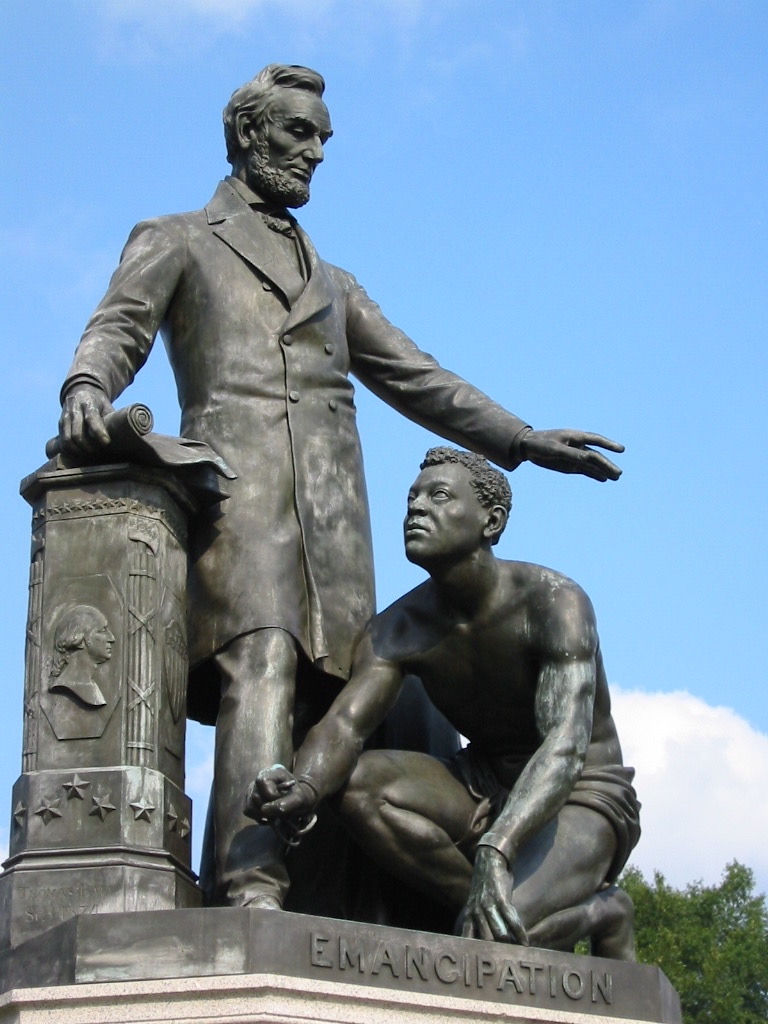
In her 1990 book, Black Feminist Thought: Knowledge, Consciousness, and the Politics of Empowerment, Patricia Hill Collins introduces the concept of “controlling images”—representations that reinforce racial and gender hierarchies and normalize oppression. While Collins' analysis focuses on representations of Black women, extending her framework to the visual field of public spaces reveals how the construction of beauty in the public commons can influence how entire peoples are perceived and understood. In public spaces, “controlling images” can appear as plaques, memorials, statues, and commemorations. Their cumulative impact can reshape our understanding of history, power, social dynamics, and even beauty. In the wake of the Civil War, Black Americans funding a memorial to honor Lincoln is a radical assertion of the right to shape the visual field of public space even if the power to fully control the expression of that vision was circumvented.
The reality is that during the brief period of Reconstruction from 1865 to 1877, Black American power to fully participate in cultivating beauty in the public commons was severely constrained. But that constraint didn’t stop them from shaping the visual field of the cultural commons and asserting their own vision of beauty. In 1867, Edmonia Lewis created Forever Free, a marble sculpture of a Black man triumphantly clutching shattered shackles and a Black woman kneeling by his side with her hands clasped in prayer. When Lewis began working on this sculpture, she was living in Rome with limited resources. She wanted to create a sculpture in honor of abolitionist William Lloyd Garrison, but financing was a challenge. She wrote to abolitionist Maria Weston Chapman, suggesting that if every Black man in the United States contributed just one penny, she could raise the funds needed to create the sculpture. Lewis offered to donate her own labor and estimated that the sculpture and pedestal would cost $1,000. A subscription campaign was organized by abolitionist attorney Samuel Sewall, attracting contributions from Black donors as well as abolitionist allies. And in 1869, at Tremont Temple, Lewis presented Forever Free in honor of a different abolitionist, Reverend Leonard Grimes. What’s striking about Lewis’ journey to create and exhibit Forever Free is that she maintained control of its design while successfully securing funding from the Black community and allies. Today, Forever Free is preserved at the Howard University Gallery of Art, which is part of a historically Black institution.
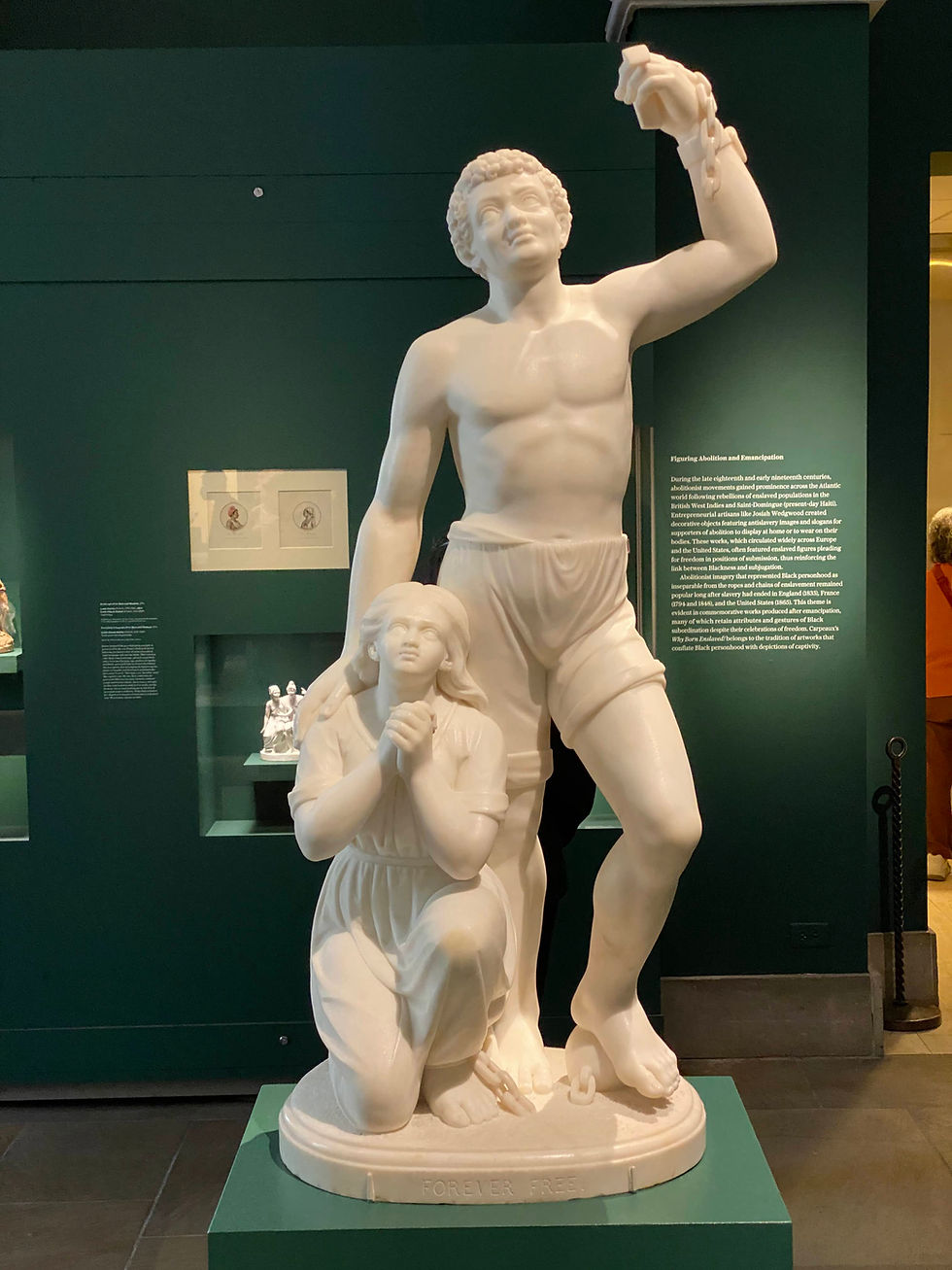
While there were some Black artists creating work in the public and cultural commons during Reconstruction, Forever Free was one of the earliest sculptures by a Black artist to represent Black people as central characters in their story of emancipation. That visual framing was profound at a time when slavery had been legal just a few years earlier. In its Nov. 6, 1869, review of Forever Free, a National Anti-Slavery Standard writer shared their impressions of the artwork:
“No one not born subject to the ‘Cotton King’ could look upon this piece of sculpture without profound emotion. The noble figure of the man, his very muscles seeming to swell with gratitude; the expression of the right now to protect, with which he throws his arm around his kneeling wife; the ‘Praise de Lord’ hovering on their lips, the broken chain, all so instinct with life, telling in the very poetry of stone the story of the last ten years.”
Edmonia Lewis used beauty as resistance and created an object that could reorganize the story of emancipation not just in the mind but in the heart of those who looked upon it. And when such objects are placed at scale in the public and cultural commons, they create the possibility that how a society understands itself can be transformed. The United Daughters of the Confederacy understood that—they created 450–700 Confederate monuments, markers, and commemorative structures around the country. That included a memorial built in Seattle in 1926 at Lake View Cemetery. In 2020, the monument was toppled by activists. Seattle-based Black artist Earl Debnam understood this when he joined the occupation of the vacant Colman School from 1985 until 1993 in an effort to have it converted into an African American Heritage Museum and Cultural Center that would incorporate history, visual art, theater, dance, and music. The Seattle School District shut off electricity, but the activists ran art exhibitions, cultural programming, and hosted a concert that helped raise money for the institution they envisioned. ARTE NOIR understood this when it became an anchor owner in the Central District’s Midtown Square, creating a permanent space for Black artists in a neighborhood transformed by gentrification and displacement. This helped to connect the public and cultural commons, providing another opportunity for Black artists to cultivate beauty as resistance.
When a Black artist creates an object of beauty in a world of erasure and domination, that act can be a powerful form of individual resistance. Even before the work is created, the artist has imagined something beyond the limitations imposed upon them. And they’ve recognized their own vision as worthy of existence. But transforming a society's understanding of itself—its history, its values, and whose lives it considers worthy of remembrance—requires the capacity to make that beauty visible, accessible, and enduring at scale. That takes more than individual vision. It requires collective action, resources, and the authority to shape the spaces we share. Beauty may begin as a personal act of self-determination, but when communities claim the power to cultivate and sustain it in the public and cultural commons, they create the possibility of transforming not only what society sees, but what it can imagine.


I love the idea of using beauty and creativity as a form of resistance. Art can be a powerful way to express identity, challenge expectations, and bring people together. It's a refreshing perspective. I also enjoy creative mental breaks with games like noillirk game, which offer a fun way to keep the mind active.