
WISDOM IN DARK MATTER: A CONVERSATION WITH SEATTLE YOUTH POET LAUREATE AHSENTI ALFEDIL
by Kōsen claudelle Glasgow
Spring is in full bloom in the Pacific Northwest— the cherry blossoms and the magnolias are just past their peak and the weather is in full pendulum swing. Ahsenti and I were fortunate to meet over her spring break on Zoom. We dialed in from near neighborhoods— her home in Columbia City and my office in Beacon Hill. She was accompanied by Garfield Hillson, the Arts Education Program Manager at Seattle Arts & Lectures (SAL), who was available for everything from hype to questions to guidance at Ahsenti’s request. When Ahsenti arrived, she had a palpable air of ease, wrapped comfortably in her blanket, savoring a slow start to her last break before the end of the school year.
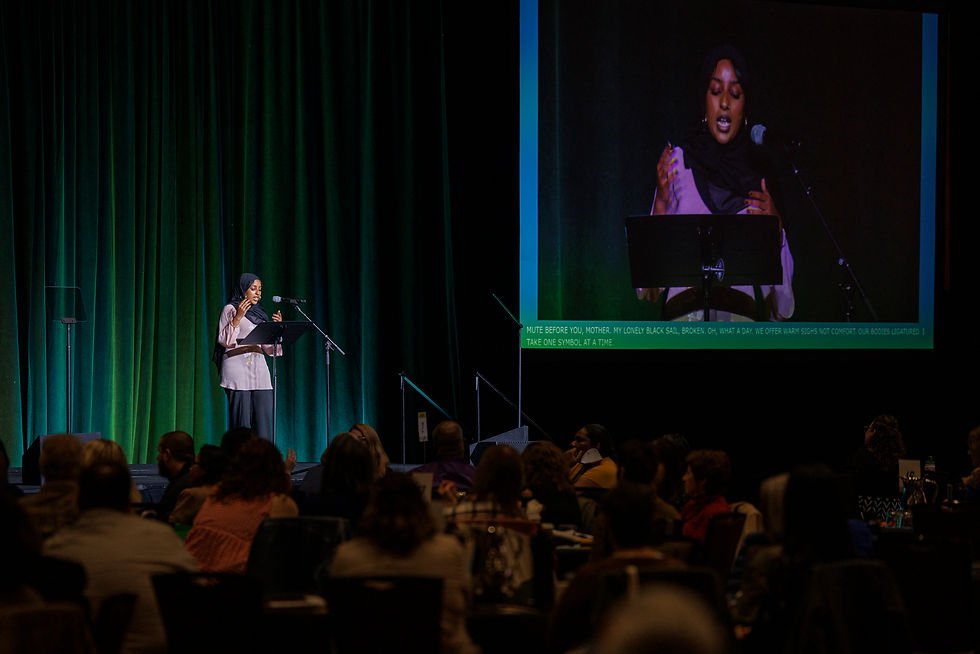
Ahsenti is a 17-year-old young woman and the middle child of 7. Her words and process are timeless– demonstrating comfort with both a windfall of conversation and silence, ever curious of the edges of growth. Ahsenti’s work seems to mirror her person– emergent, immersive, and with the dexterity to unearth beauty and wisdom from salvage. This upcoming collection seems to move from spare text, as in "I imitate myself," creating space for possibility, to expansive text, with"Vertigo," creating room for collapse and the interrogation of parts. One cannot help but leave her work and consider the question Will you help me change the world with this salvage?
We spoke about identity, family, vulnerability, and, of course, her forthcoming chapbook published by Poetry Northwest Editions, which will be launched with SAL on June 23, 2026, at Elliott Bay Book Company.

What are your thoughts about truth and its connection with your creative work?
I think everyone just wants to be authentic, and at our age, everything around us always feels inauthentic. But I think when you have a creative endeavor, it's your way of sifting through what is really there. Being a creative is just my way of muting out what is not my voice, and that’s how I figure out what my truth is. And the thing about it is, it’s always changing. I think for me it's a feeling. It's really elusive. I’m not doing it just to perform– it comes naturally.
A feeling and also an embodiment. Does that resonate?
Definitely. When I get that spark, it's usually in creative spaces. I’m taking a creative writing class for poetry, and we’re constantly working with each other, with our work. Just hearing people say–‘that’s actually what I am trying to say!’ and ‘This is my work right here.”– that’s discernment coming to them. They are figuring out who they are as poets, even me. It’s amazing to see!
"Being a creative is just my way of muting out what is not my voice, and that’s how I figure out what my truth is."
Can you say more about the creative writing class?
It’s semester-long. My advisor teaches it, Jasimé Smith– she’s also a poet. I adore her class. I tried to run a creative writing club, but people were so shy. I wanted to pull all the people I knew were poets at heart, who knew how to write, but they didn't want to be vulnerable– even if it was something that we could all relate on. I’m also very introverted, but trying to get people to do that was really tough. Being with people who are also very comfortable with being vulnerable, with a teacher encouraging it, is amazing!
In your bio, you mentioned having a “resistance to categorization.” Can you tell me more about that and what wisdom that gives your own life?
In workshop specifically, when people are like you’re like this, like it is who you are, I feel more like this is who I am right now. It’s not who I am completely. In my home life, when adults are trying to describe a child to another adult, it riles me up. So I think from there it fed its way into my writing and you can see that. You can’t be that definitive.… there are so many layers.
What has been catching your interest of late, aside from chess?
Not much recently because I have been focused on this research paper on the Tulsa Race Massacre. It is focused on the silence that happened afterward. So, how do you figure out silence? I think poetry has found its way into my analysis for sure!
Please tell me about this chapbook– the inspiration, title, whatever you can release.
The title is Sweetness of the Spoil. I think this was a hard thing to figure out because I was compiling things every week and sending things to my mentors–so they were very random. A big part of the process was organization. During the editing process, there were some things I didn't want to let go of; they looked good together until someone had to say, Let them go. I have haikus that are sort of the pause for each chapter. They play a big part in the interpretation as well.
There’s a poem in there called i imitate myself.
i imitate myself,
a metaphor for things
that rot to stay alive.
It talks about rot and decay, like a shedding almost, and the haiku that introduces that poem is about that– bed bugs and pinching skin.
The chapbook itself is a shedding of skin, for me, this era of my life. I graduate next year. This was a debut for me– the fellowship, working with SAL, and being in the spotlight. So Sweetness of the Spoil is very much the rot and the art, the beauty and the wisdom. I didn't really understand who I was writing this poem with the other poems. It didn't make sense together until I figured out– this is all I was before– the shedding of that skin.
People don’t always gravitate towards the dark matter, so this feels timely.
Totally. I think realizing at the end this was meant to happen– even though I couldn’t see it at first. It was figuring out imperfections and why it was purposeful for the whole collection.
Did moving through this process change you in any way?
Oh, I think for sure. It’s wisdom for myself too. The fact that I created it means the wisdom was from me– realizing being imperfect and growing out of that.
Are there any cultural beings that are informative to your work?
I made mention, many mentions, in the book of Eve L. Ewing. I read this poetry book from her that was gifted to me while I was writing a few poems– it was like my music. She was my muse and I admire her simplicity (of language)–it rolls off the tongue. When I was writing the poems, sometimes I felt very convoluted and she was my breather. And I relate to a lot of the things she talked about, especially at my age as a Black girl.
Sometimes I would just replay the same song over and over until I finished the poem. There was that feeling that came from the song, the foundation of the poem, so I couldn’t not listen.
Anything else you want to share?
Ahsenti offered another poem, Vertigo, but also some words:
Vertigo
lying is the most honest thing about us
touch and grab to claim everything yo-
urs nothing is tethered to you so I roll in
to a self-inflicted dizzy 23 months heav
y 66,700 to 680,000 an elbow is just a
bent arm with ambition I heard Ewing
say you run because no jet will wait for
you but it will to kill you hungry and ug
ly your skin the most classical thing abo
ut you its how I’ll remember you yk
not classy dont get it confused I dont
dance and If I do I get all spinny and
I’ll swish my dress and hope I get on tv
too big of dreams so instead I etch her
name in a tree & pray there’s room for
me the puppet string from the inseam la
ys untethered to me quick turn and it st
ill burns my insides how much do you mind?
I have a lot of self-awareness when it comes to my own growth, but when I look at the world and see those areas of growth, I childishly want them to be fixed right now. It is helpful to know that people see what’s going on and know it’s not how it should be. We have a standard of humanity that should be followed through and is innate in all of us. It is comforting in a way, not to say things should stay as they are, but that there is not complete hopelessness.
Hope knowing things are visible?
Yeah, exactly.
Even if it is ugly, ugly rot?
I see what you did there– a good way to tie it with the book!
ABOUT THE YOUTH POET LAUREATE

Ahsenti Alfedil (she/hers) is a first-generation American of Ethio-Sudanese descent and a student at the Bush School. A multidisciplinary Piscean, she moves fluidly between poetry, acrylic/oil painting, and movement—always led by curiosity and feeling. When not overwhelmed by her academic workload, she finds joy in braiding hair, spending hours adorning herself and loved ones in henna, skating to her favorite playlists, and research as a leisure activity. As a writer, Ahsenti turns most often to poetry. Her work shows resistance to categorization because she follows her intrigue; the fleeting moments that spark inspiration to create. Through her writing, she hopes to make space for those navigating layered identities, vulnerability, and for stories that make people feel seen in their most intricate and unspoken parts.
ABOUT THE AUTHOR
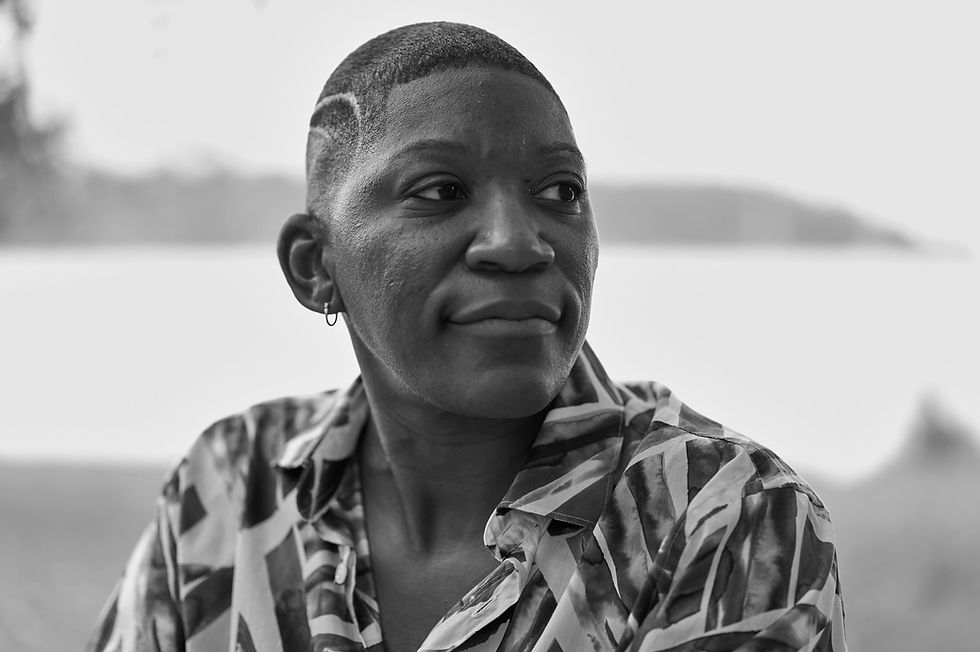
Kōsen claudelle Glasgow is an interdisciplinary poet, somatic psychologist & Buddhist chaplain. cross-discipline, their work is invested in the exploration & play of the roots of personal & collective suffering, disrupting fixed ideas of embodiment, time & memory through a Caribbean-American patois. the work centers survival but also highlights the unexpected nurturance from dark spaces. Their chapbook the Devils that raised Us was longlisted by Frontier Poetry & a 2023 Best of the Net nomination in poetry. doc has obtained several residences & fellowships & recent work can be found in the 2024 Emerge Anthology, Obsidian: Literature & Arts in the African Diaspora, Black Lawrence Press & Callaloo.


Eventually, actions that once required concentration start becoming natural. That progression makes the Football Bros game rewarding. It is also fun to look back at earlier mistakes and realize how much your decision-making has improved. For players who enjoy mastering mechanics, there is plenty to appreciate here.